

In Sri Lanka, the foreign exchange rate plays a pivotal role in the nation’s economic success. An evaluation of exchange rate movements from 2015 to the present reveals a sharp upward trajectory, with future forecasts indicating the continuation of this trend.
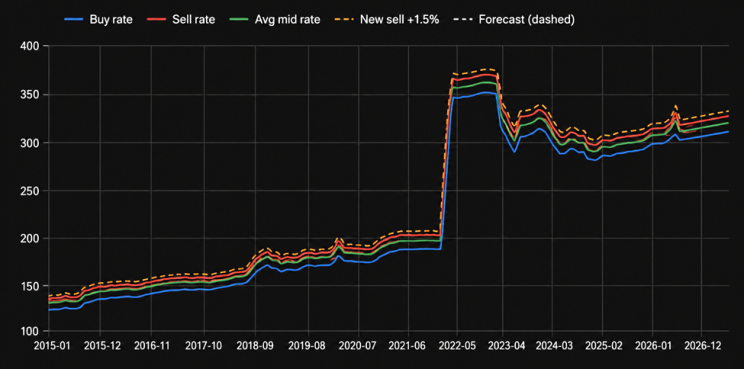
USD exchange rate analysis — 2015 to 2026 showing Buy, Sell, Mid, and Forecast lines (Based on historical
exchange rates from the rate published by Central Bank of Sri Lanka from 2015 Jan to 2026 May)
The Three Eras of the Rupee
The data tells a clear story of three distinct economic eras: a decade of gradual, managed depreciation from 2015 to 2021; a catastrophic, crisis-driven collapse in 2022; and a slow, painful recovery that is still underway from 2023 to 2026.
The mid (average) rate serves as the most neutral reference point for both policymakers and analysts. Sitting consistently between the buy and sell rates, its trajectory tells the same depreciation story while removing the noise of bank margins.
The gap between the buy and sell rates, known as the spread, is a hidden cost that is often ignored in mainstream discussions. The spread data tells a striking story on its own. Through the period of 2015 to 2021, the spread was a tight LKR 3.5 to 4.7, signalling competitive and liquid markets. However, when the crisis hit in 2022, this spread exploded, eventually peaking at LKR 16.8 in March 2023. This meant banks were pricing an LKR 16.8 uncertainty premium into every dollar transacted. This acted as a direct tax on every import and export during the crisis period. As of May 2026, the spread has narrowed to LKR 8.8, but it remains roughly 2.4 times above the pre-crisis norm. A fully normalised market would typically show a spread below LKR 5.
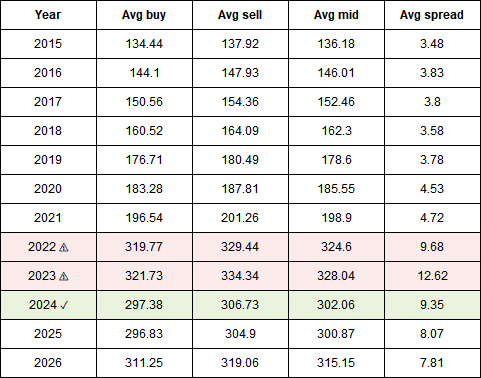
Annual averages — buy, sell, mid & spread (Based on historical exchange rates from the rate published by
Central Bank of Sri Lanka from 2015 January to 2026 May)
What the Exchange Rate Trend Tells the Business Community
The business community must internalise a crucial reality: the rupee is not simply weak. Rather, it reflects Sri Lanka’s structural trade deficit and insufficient foreign exchange earnings.
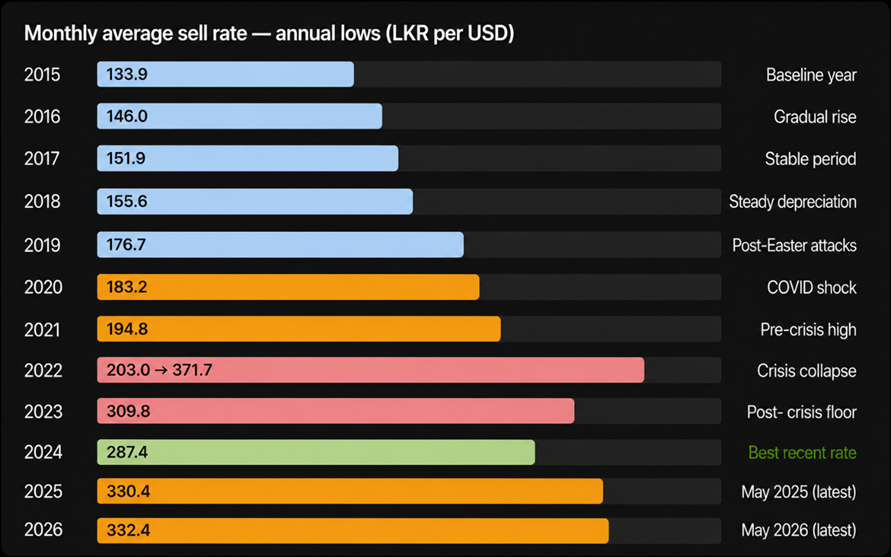
The best rate in history was ~LKR 287 in Nov–Dec 2024, reflecting IMF programme discipline, forex reserve
rebuilding, and reduced import demand. The pre-crisis baseline of ~LKR 134 (2015) is a benchmark that
reflected a different economic structures
- Cost pressure on import-dependent sectors: The rate rising from LKR 134 in 2015 to LKR 332 in 2026 means the landed cost of raw materials, machinery, fuel, and consumer goods has more than doubled in LKR terms. Manufacturers dependent on imported inputs face severe margin compression unless these prices are passed to consumers, ultimately feeding inflation.
- Exporters gain a competitive edge: Sectors such as apparel, tea, rubber, IT/BPO, and tourism earn in USD or EUR but pay wages and overheads in LKR. A weaker rupee automatically boosts their LKR revenues and profit margins, rewarding export-orientated businesses that kept their dollar earnings onshore.
- Crushing foreign debt servicing: Any business or government entity holding USD-denominated loans saw their repayment costs surge 2.5 times in LKR terms. The 2022 crisis, where the rate jumped nearly 82% year-over-year, made this an existential threat. Hedging strategies and forex management are now board-level priorities, not mere accounting details.
- Volatility destroys investment certainty: The +28.9% month-over-month spike in March 2022 and the -8.5% collapse in March 2023 signal a market that severely punishes long-term planning. Foreign Direct Investment (FDI) slows down when investors cannot reliably price project costs or repatriated profits. Stabilising the rate is therefore a prerequisite for attracting capital, not a consequence of it.
- Erosion of domestic purchasing power: For businesses selling into the domestic market, a weaker currency means their customers are poorer in real terms, even if nominal incomes appear stable. Consumer goods, retail, and hospitality face demand destruction as households are forced to allocate more income to essential imports like fuel, medicine, and food.
- The post-crisis window for reform: The rate declined from a peak of roughly LKR 371 in 2022 to approximately LKR 287 in late 2024, marking an appreciation of about 23%. This stabilisation window signals restored IMF-backed macro stability. Forward-thinking businesses should utilise this time to lock in medium-term contracts, hedge exposures, and invest in import substitution or export capabilities before the next shock.
Future Outlook: Can Sri Lanka Achieve LKR 200 or LKR 150?
When questioning whether the rupee can return to LKR 200 or LKR 150, the honest assessment is that LKR 200 is achievable within a decade under the right conditions. However, LKR 150 is a generational aspiration, not a realistic planning assumption.
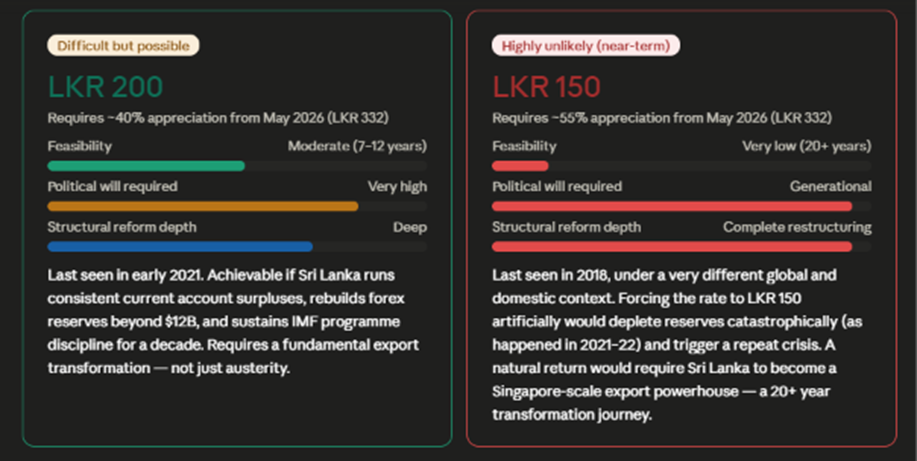
Difficult but possible: LKR 200 and Highly unlikely LKR 150
- LKR 200 (Difficult but possible): This requires an approximate 40% appreciation from the May 2026 rate of LKR 332. It is achievable only if Sri Lanka runs consistent current account surpluses, rebuilds forex reserves beyond $12B, and sustains IMF programme discipline for a decade, alongside a fundamental export transformation.
- LKR 150 (Highly unlikely near-term): This requires a massive 55% appreciation from May 2026. A natural return to this rate would demand Sri Lanka become a Singapore-scale export powerhouse, requiring a 20+ year transformation journey.
A Critical Warning for Policymakers:
The worst action policymakers could take is attempting to artificially engineer either of these numbers. Artificially pegging or defending the rupee at LKR 200 or 150 without the underlying macroeconomic fundamentals would repeat the fatal error of 2021–22, when an overvalued fixed peg triggered the worst economic crisis in the nation’s post-independence history. The 2021–22 crisis happened precisely because the exchange rate was held below its market-clearing level through severe reserve depletion. When the reserves finally ran out, the rate did not merely fall to an equilibrium; it catastrophically overshot to LKR 370. Any rate reduction must be earned organically through genuine export growth, FDI inflows, and reserve accumulation. Real, durable appreciation can only come from the supply side. The best rate achieved recently was approximately LKR 287 in late 2024, and that was earned through painful IMF-backed fiscal consolidation and reduced import demand, not through inherent currency strength.
Strategies for a Sustainable Exchange Rate
The path forward requires a comprehensive 10-year transformation rather than policy shortcuts. Sri Lanka must adopt the following pillars to sustainably strengthen the exchange rate:
Pillar 1: Earn More Foreign Exchange (Supply Side)
- Aggressively grow goods and services exports: Sri Lanka must expand beyond apparel and tea to target high-value IT/BPO, pharmaceutical manufacturing, premium seafood, and value-added agricultural products. A national export target of $25B by 2030 should be established, up from roughly $13B in 2024. High commissioners and ambassadors must play a major role in driving this. Every additional dollar earned structurally reduces pressure on the rupee.
- Maximise tourism receipts: Following the crisis recovery, tourism earned roughly $2.3B in 2024. A target of $5–6B is achievable within five years through the development of premium, eco, and health tourism. A core question is whether our infrastructure can support increasing daily tourist spending from the current $181 to match the Maldives average of $300 to $550+. This requires building isolated luxury resorts with direct flights, reliable airport transfer systems, and premium activities. Each tourist dollar directly supplies forex to the banking system and reduces the trade deficit.
- Formalise worker remittances: Remittances, bringing in approximately $6B annually, are Sri Lanka’s single largest forex earner. Closing the parallel market gap through competitive official rates and simplified conversion can shift billions from black-market channels into the formal banking system.
- Attract quality FDI: Sri Lanka averaged less than $1B per year in FDI from 2019 to 2024, falling well below regional peers. Establishing dedicated investment zones with 5-year tax certainty, clear land titles, and dispute resolution reforms can multiply patient, long-term capital inflows.
Pillar 2: Spend Less Foreign Exchange (Demand Side)
- Drive import substitution: Sri Lanka imports approximately $4–5B in fuel annually. Accelerating renewable energy projects (solar, wind, mini-hydro) directly reduces this dependency. Scaling domestic food production will also reduce the $1.5B food import bill. Every dollar saved on imports is one less dollar of demand on the forex market.
- Maintain a market-determined float: The Central Bank (CBSL) must resist political pressure to burn reserves defending artificially strong rates. A managed float with transparent intervention rules preserves credibility.
Pillar 3: Structural Credibility and Institutional Reform
- Complete the IMF EFF Programme: The IMF Extended Fund Facility (2023–2027) requires fiscal consolidation, SOE reform, and debt restructuring. Completing it in full rebuilds creditor confidence and unlocks bilateral support. Countries that exit IMF programmes early typically relapse into crisis within three years.
- Rebuild forex reserves: At the lowest point of the crisis, gross reserves fell below $1.6B, which was barely one month of imports. The CBSL target should be over $10B (representing 4–5 months of imports). Adequate reserves act as a necessary shock absorber against external threats.
- Reform state-owned enterprises: Historically, the Ceylon Petroleum Corporation (CPC) and Ceylon Electricity Board (CEB) have been the two largest drains on the national forex pool through subsidised imports and accumulated losses. Their commercial reform or privatisation will eliminate a structural source of currency weakness.
- Develop a deep domestic capital market: The nation’s reliance on International Sovereign Bonds (ISBs) created hard-currency debt that triggered the 2022 crisis when rollovers became impossible. Deepening the domestic bond market, alongside pension fund reform and diaspora bond instruments, will reduce the long-term structural dependency on foreign currency borrowing.